
Perchance
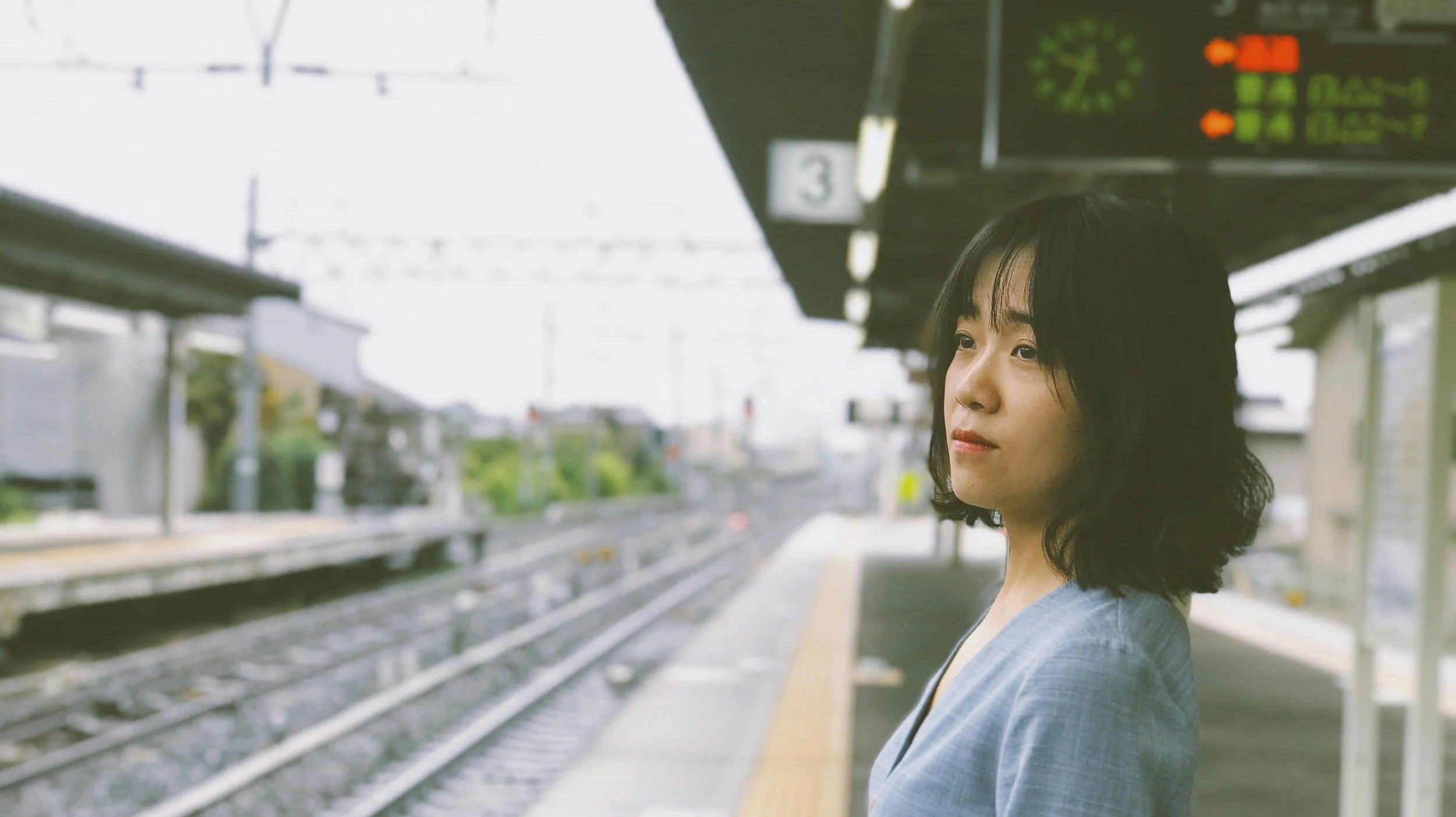
Photo credit: Cardia Gong | Unsplash
Beyond the Shinkansen window, lush green mountains and a vast ocean glisten under the blazing sun, rolling by like fast-forwarded scenes. The LED panel above the compartment door repeatedly displays “Next stop Atami, Atami” as the recorded announcement urges passengers to prepare to disembark. All at once, the bustle of vacationers gathering their boogie boards, beach toy bags, and fishing poles fills the late Friday afternoon train. When Itsuki stands up to grab his duffel bag from the overhead rack, the train suddenly decelerates, knocking him off balance, then stops with a soft hiss. His bag, packed the night before by Misa, slides forward and bumps into a carry-on with a lucky-bell charm.
Instinctively, Misa’s hand reaches for her water bottle on the window sill, but the cap rolls onto the floor.
“I’ll get it,” Itsuki says. But the lights go out, and all the passengers are thrown into darkness.
As her husband fumbles with his cell phone to turn on the flashlight, Misa places her hand on her stomach and swallows the excess saliva that keeps welling up. Nothing can be done about it, her obstetrician told her. Like other discomforts, she has to endure it, hoping it will pass in her second trimester.
“You okay?” Itsuki holds up his phone and peers into Misa’s face.
She pushes the phone away and leans back. No cool air is coming from the ceiling vent.
The panicked passengers repeat—“What happened? What’s wrong?”—in a futile attempt to get information as the furious tapping of keyboards echoes like machine guns from all directions.
When the emergency lamp lights up, Itsuki sees his reflection in the window, which is only a few centimeters from a concrete wall.
“Seems like we’re stuck in a tunnel,” Itsuki tells Misa and glances at his Swatch. It is 6:05. Once the train resumes service, they should arrive at Atami in under ten minutes. Ample time to make it for the sunset dinner he had reserved to celebrate their fifth wedding anniversary. “No worries. I’m sure the train will start rolling in a few minutes.”
Misa sips some water, annoyed at the typical, groundless assurance that Itsuki gives her. Like last night in bed. Flipping through Vogue, when she told him she regretted quitting the agency to have their baby, although the decision then seemed reasonable, given the irregular, long working hours and frequent business trips she had to make, he nonchalantly said, without even raising his eyes from the Nikkei papers, that she would immediately find a PR job once she decided to resume her career. Such crap. What does a banker, dealing with mortgages and collateral, know about advertising? She can’t believe his baseless remarks once-upon-a-time cheered her up, made her feel protected, loved.
The overhead PA clicks, and a conductor’s deep voice hushes the passengers. There’s a power outage. We will update you as soon as we have more information. In the meantime, please stay seated.
“Looks like we’ll be in the tunnel for some time.” Misa stretches her legs, looking at Itsuki’s reflection in the window. She reminds herself how much time Itsuki spent planning this overnight trip, searching for a resort with an ocean view, close enough to Tokyo so the train ride wouldn’t be strenuous for Misa. He is kind. Trustworthy. Husband material, as her best friends from college put it when she announced her engagement to him.
An hour passes without any real update from the conductor. Meanwhile, the compartment becomes stuffy, wearying the passengers. Itsuki no longer wears a necktie, and sweat runs down his back. The two haven’t spoken in the last thirty minutes—Itsuki exhausting his pep talks, and Misa her smile.
As Itsuki hovers his cursor over the map showing several beach trails, he receives an email from a realtor who has been helping them search for a house. In the photos, the property looks perfect, the ideal match for what they’ve been looking for. Cozy, yet spacious enough for a family of three, maybe four. As Misa hopes, the three-story house is painted white and features large sliding doors that open onto a wooden balcony. Hopefully, this will end his weekend of waking up early to visit suburbs with fairy-tale names like Lily Hill and Thistle Plain, all sharing the same mega supermarket, coffee shop, and bus terminal in front of the main train station. They used to have fun joking: Itsuki calling their weekends déjà vu moments, and Misa referring to new developments as parallel worlds. But after Misa became pregnant, she changed—though Itsuki can’t quite name what that change is. Nowadays, talking to her is like drinking a beer to quench your thirst, only to find it flat. But this house might hit the right note, make her bubbly.
“Misa?” She gives him a blank look, making Itsuki reconsider showing her the photos. “Do you want more water?”
“Done working?” she asks as he shuts his laptop. Unable to hold her bladder, she doesn’t wait for his response but walks straight to the restroom, only to discover that the toilet doesn’t flush without electricity. When she returns to her seat, she finds Itsuki’s unopened water bottle on her foldable table. She’s determined not to drink it and waves at Itsuki. “Thanks. But no thanks. If I drink another bottle, I’ll burst.”
Our task force identified the cause of this outage. A snake that crawled up the pole caused a short circuit in the wire. It is currently being removed. We’ll update you as soon as we get more information.
“A snake?” Misa shakes her head in disbelief.
Itsuki rolls his eyes. “One in a million chance.”
“You make it sound like it’s a lucky day.”
“Don’t know about that, but this year is the Year of the Snake.”
“Then this should be the story we tell our baby,” Misa says, patting her stomach.
Itsuki considers opening his laptop to show her the house, but is interrupted by another announcement.
Safety check is underway. We expect to resume our service in about thirty minutes. Thank you very much for your understanding.
A girl around six, sitting across the aisle, parrots the announcement, adding hisses at the end of each line. When her mother hushes her, the girl makes funny faces at passengers strolling or stretching in the aisle. A man wearing earbuds walks past Itsuki’s seat and then steps back, breaking into a broad smile.
“Itsuki!” Hinata exclaims.
Twelve years haven’t changed them. They immediately recognize each other—friends from college, the trio who spent more time in the school cafeteria than in class. Out of the corner of his eye, Itsuki sees Misa sitting upright and tucking loose hair behind her ear.
“What a coincidence!” Hinata takes out his earbuds. Wearing a neatly pressed white t-shirt, sky-blue linen pants, and beige suede loafers on bare feet, Hinata appears much younger than Itsuki, who is dressed in his navy-blue suit pants from work, where casual Friday isn’t a thing.
Itsuki rolls up his sleeves and stands, peering over the seats in front of him to see if they’re occupied. “So, where have you been all these years? Didn’t you get the invitation to the Incredible Magician Club’s reunion?” He lightly punches Hinata’s chest like old times to wash away any accusatory tone his questions might have carried.
“Let me tell you my story,” Hinata says, flipping the lever of the front seats to rotate them 180 degrees. He sits across from Misa, their knees almost touching. “Firstly, belated congratulations. I heard you got married.”
“Five years ago,” Misa says, placing her hand on Itsuki’s lap. “And you?”
Hinata chuckles. “You know I’m no husband material. Besides, I’ve been traveling all over the Middle East, working at various refineries. Gorgeous countries.” He pulls out his cell phone and shows them panoramic photos of the Tuwaiq Escarpment, Shanidar Cave, where Neanderthal remains were found, and Khor Al Adaid Beach with its constantly shifting dunes. Sometimes, when Hinata hears Misa’s soft “ooh” and “aah,” his finger scrolling through the pictures pauses briefly, recalling the touch of her gentle skin. Twelve years, he muses, and watches the two admire his photos. When his eyes meet Itsuki’s, he’s caught off guard, like a kid sneaking a cookie from a tin, and blurts out, “Amazing,” to hide his embarrassment.
“No wonder we lost track of you. At the reunion, we were saying you vanished like a coin.” Itsuki takes the cap from his water bottle and performs a sleight of hand, but he drops the cap, and it rolls under Misa’s seat. “Still all thumbs. But you were so good at it. The star magician at a charity show.”
“And Misa, in that black sequin jumpsuit, was a knockout assistant whom–” Hinata pauses when the overhead PA kicks in.
Safety check is progressing steadily…
Hinata shakes his head, annoyed at hearing no new information. Losing his train of thought, he continues, “Anyway, what I meant to say is that you got lucky, Itsuki. You got Misa.”
They all laugh, avoiding each other’s eyes, and wait for someone to pick up the conversation, steer them to safer ground.
“What’s funny?” A little boy, holding his toy train, perches beside Hinata before his mother can stop him.
Hinata mouths, ‘never mind,’ to the young mother cradling a newborn in a baby sling. “Do you want funny?” he asks the boy and picks up the cap beside Misa’s sandal. He makes it disappear and reappear between his fingers. The boy gapes at Hinata’s hand and swings his dangling legs.
They could be a father and a son, Misa thinks, as unwanted memories flood her. Those honeycomb surgical lights staring at her, that sense of guilt and sorrow, that numbness dragging her into soundless darkness, knowing she’ll be without her child–Hinata’s child–when she opens her eyes again. Was it a boy or a girl? Their never-born child, who would have turned twelve, whom Itsuki knows nothing about.
The safety check is almost finished. We will resume the service soon.
“Are you alright?” Itsuki whispers into her ear. “You look pale.”
“Maybe I should walk around a little.” Avoiding the boy’s kick, Misa manages to get out of her seat and heads toward the back of her compartment.
The boy’s mother calls him, enticing him with a lollipop, and bows to Itsuki. When the boy jumps out of his seat and runs, it looks as if he’s tagging along with Misa. Like a son frisking behind his mother, eager to hold her hand. In that moment, Itsuki clearly sees his own future. He’ll stay with the bank until retirement, pay off his mortgage, and vacation once a year with his family in the countryside in Japan. Nothing fancy. Nothing exotic. He’ll never see the Tuwaiq Escarpment, the Shanidar Cave.
Hinata stretches his legs and yawns, checking his sports watch. Time seems to have stopped for Itsuki and Misa, while it has thrust Hinata into another world. They share nothing in common except a few years of their youth. With nothing else to talk about, Hinata mentions having to play golf with his clients on Saturday, an event he doesn’t look forward to. But business is business, he says, and asks Itsuki whether he plays golf.
Itsuki shakes his head.
Since it is her eighth week, Itsuki can tell Hinata doesn’t realize that Misa is pregnant. He wonders whether he should bring it up. If he did, would Hinata remember that rainy evening when he came to Itsuki’s apartment, asking to borrow money? It was a lump sum equivalent to his monthly expenses. Hinata said he couldn’t ask his parents. A secret only between the two.
Itsuki had been saving up money to backpack through Europe. How many times had he spread the atlas on his tatami mat and shown Hinata and Misa where he’d planned to go: Sagrada Familia, Venice, the fjords? Itsuki had hoped that the two would join him. He imagined Misa sitting across from him on the night train, leaning her head on Hinata’s shoulder, her mouth half-open as if she had fallen asleep in mid-sentence.
“While in the Middle East, do you get to travel to Europe?” Itsuki asks.
Casually, Hinata lists the cities he’s visited—Athens, Rome, Barcelona—and folds his fingers to make sure he doesn’t miss any.
Hinata had returned the money to Itsuki long after they stopped practicing magic together, stopped drinking at Itsuki’s apartment on Friday nights. If Itsuki had considered money as just money, he would have gone to Europe the spring after graduating from college. But the money reminded Itsuki of the abortion, the secret he shared with Hinata, and the moment their relationship fell apart.
“We apologize for the inconvenience we have caused you. The train will be moving shortly. Please return to your seats. The next stop is Atami.”
Misa slides into her seat, relieved that everything is back to normal. The lights are on. The pixelated digital display scrolls and flashes above the door leading to the next compartment. They are exiting the tunnel.
“Without this mess, I wouldn’t have caught up with you guys,” Hinata says. “So, don’t we owe it to the snake?” He taps his cell phone and pulls out his e-ticket. He’ll have time to stop by a sushi bar, chat with a local girl, or a tourist from abroad. He’ll see where his luck takes him tonight.
Neither Itsuki nor Hinata offers their email address or phone number to the other. When the door opens at Atami, Itsuki, Misa, and Hinata get off the train and go their separate ways. From the front seat of the van dispatched from the resort hotel, Itsuki and Misa watch Hinata disappear like a phantom into the night.
“Hinata is Hinata,” Misa mutters.
Itsuki pretends not to hear her. Like what happened with the train, their reunion is an accident. Not a life-threatening one, but an accident all the same. Hinata might or might not hear from their college friends about Misa becoming a mother. Unless Itsuki tells her, Misa will never find out that the abortion money came from him. He will keep it a secret. Not because he doesn’t want to hurt Misa, but because Itsuki can’t explain why he opened his drawer that rainy day, dug out the envelope hidden under his sweatshirt, and handed it to Hinata, who showed no doubt in Itsuki catering to his needs. Such confidence. Such self-ease, Itsuki will never have.
They were twenty, just a year away from graduation and a promising future. Wasn’t having an abortion the logical choice, the only responsible one? Itsuki convinced himself he was saving his best friends. Misa and Hinata could get married in a few years and have children. Itsuki could be the MC at their wedding, sharing funny stories to make the guests laugh.
Did he really believe in that happy ending? Deep down, hadn’t he hoped the two would break up? Not after rounds of calling names and crying, but a quiet disintegration like soap bubbles popping in the wind. Itsuki had wanted to believe he had saved Misa from further hurt and possible betrayal. But when she and Hinata broke up, Itsuki’s friendship with Misa suffered. She avoided him on campus. He felt blamed for the wrongdoing he didn’t commit, for reminding Misa of Hinata. He realized then that he was tangential, a mere shadow of Hinata.
So, years after graduation, when Itsuki ran into Misa at a bookstore, he didn’t expect her to acknowledge him, let alone ask him out for coffee. He had quickly fallen in love with her again.
When Itsuki opens the door to their suite, they are greeted by a wall-to-wall window that opens onto a cantilevered balcony facing the ocean. The sun has set, and the lights of Hatsushima Island shimmer in the distance. It is too dark to see, but they hear the waves crashing on rocks beneath the balcony.
“Amazing,” Misa says, leaning her head on Itsuki’s shoulder. “Thank you.”
“We missed the sunset, but we can still enjoy our anniversary dinner here on the balcony.” Itsuki picks up the menu from the glass table and shows it to her. “I’ll call room service to start our dinner in thirty minutes, okay?”
While Misa takes a shower, Itsuki sprawls on a chaise lounge sofa, fluffing up and rearranging the plush cushions to support his back. When he turns on the TV with a remote, the screen fills with an image of a dead rat snake. The caption reads: the culprit of a two-hour bullet train delay. Its slender body is stretched out on a concrete pavement alongside a retractable tape measure. About a meter long. The scales that must have been sleek are scorched, its upper body shriveled. “6,600 volts. An instant death,” the reporter says.
He wonders whether Hinata is watching the same news. Remembers the way they had both gazed at Misa, swirling a red scarf while walking up and down the stage, before stopping at the center with a radiant smile. She wrapped the scarf around her neck and tightened it. Her eyes widened as she pretended to tense the knot. When the noose came loose, Itsuki and Hinata clapped until she went off stage, leaving the children at the orphanage gawking.
Standing under the shower, Misa slowly turns the knob. Cold, then lukewarm, then hotter, until she can’t turn it any further. The jet of very hot water stings her. As the acrylic panels fog up, she thinks of Hinata on the train, tries to finish his incomplete sentence: whom I’ve loved? I’ve left? I’ve forgotten? All sounds right. All sounds wrong.
“Is everything alright?” Itsuki shouts over the running water.
Misa turns off the shower and wraps herself in a thick, soft towel. As she sashays toward the sofa, her towel slips loose and falls to the floor like shed skin. Itsuki looks up at her as if seeing her naked for the first time.
Editor’s Note
You need to read this story twice to fully appreciate Norie Suzuki’s use of subtlety and metaphor. “Perchance” is about things unsaid, about three characters who each know a part of the story, and who each believe that withholding the full truth is an act of kindness to the others. As a result, they all live in restrained silence with their partial secrets.
The symbol of the snake serves as a double metaphor–both as the tiny “creature” with the power to stop everything (paralleling Misa’s and Hinata’s history), and also as Misa’s shed skin in the final scene.
Suzuki’s “Perchance” is a beautiful story of emotional restraint and quiet longing. It asks the question of how we move forward in life and love, even as we look back on what if?
Josh Boldt, Editor
Story Track
You can just feel the longing in “Scarlet” by the Japanese rock band ART-SCHOOL. A deep ache, a yearning for something lost. The lyrics go so well with Norie Suzuki’s story “Perchance.” Lines like “I'm thinking it's someone else’s fault that we changed / And that we have made a mistake” and “Why do I want to touch you now / I want your body when I can't see you” parallel both Misa’s memory of her time with Hinata and her present with Itsuki. They all shared an experience that changed everything and sent their relationships on a course that would be forever altered.
Was it a mistake, as the ART-SCHOOL line suggests, or perhaps the outcome was as it should be? And don’t we all sometimes wonder how our lives would look if we’d made that one different decision? Like Misa, we gather ourselves, shed our skin, and continue on the best we can.