
Gyotaku
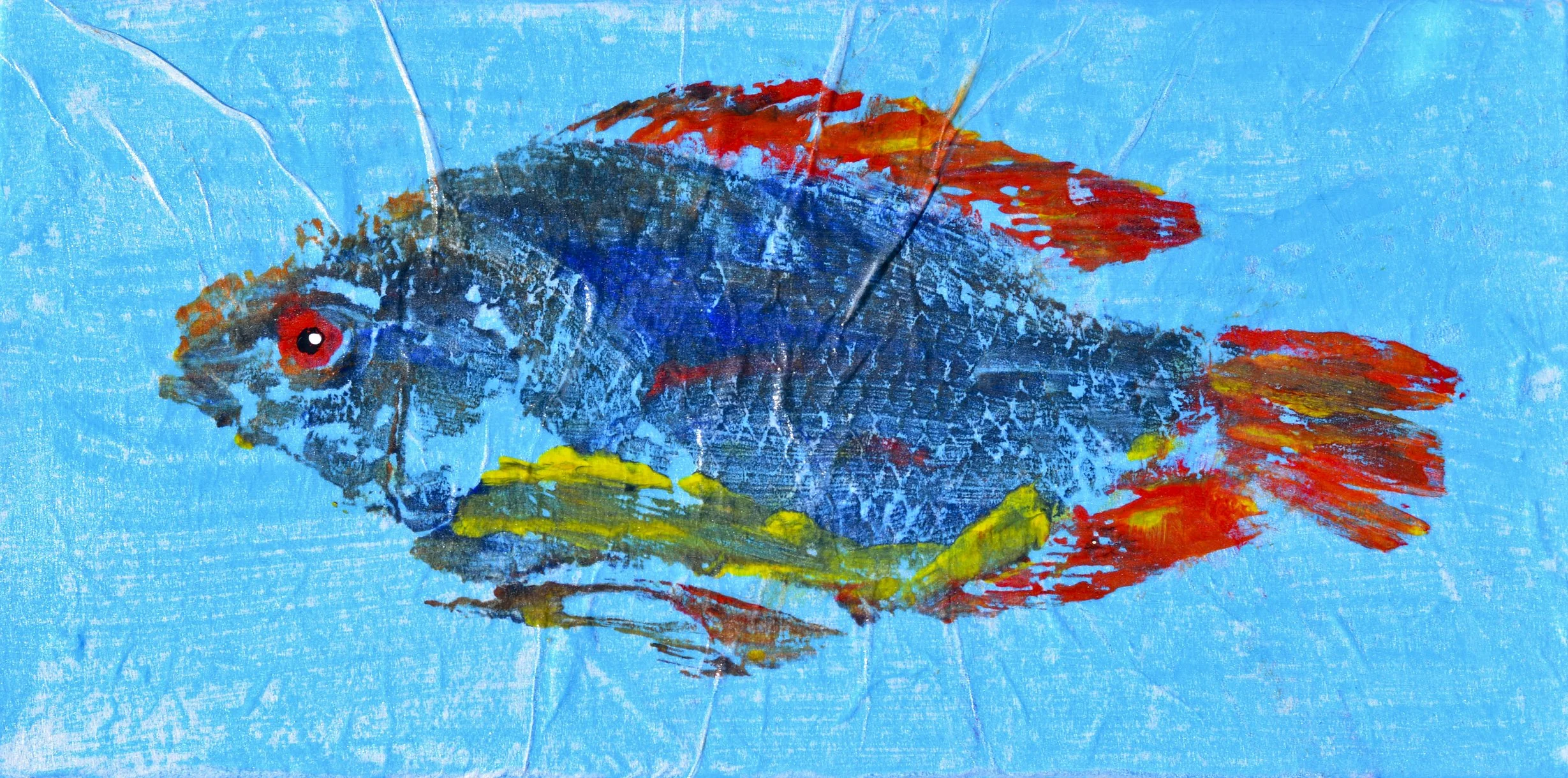
Photo credit: Steve Gibson / Dreamstime.com
My father papered the walls of his studio in crisp white washi, covered in schools of Gyotaku: ink prints of fish he’d caught throughout his career. I probe the paper like I’m noodling for a bite until I fumble on the light switch. The LEDs mimic natural light–my father would accept no less. He demanded his works be displayed bathed in sunlight.
They usually are, I suppose, though an overpriced sushi restaurant or a software developer’s beach house probably isn’t what he had in mind. In the last month, all those pieces have been resold for ten times the original price. Even these walls are likely worth hundreds of thousands, now.
My father was a much better businessman than I thought, if it’s true what they all say. If he meant to die.
I brace my hand against the wall, beside the notch where his ancient fishing rod should be hanging. But it’s not, anymore, not since he used it to—
My eyes screw shut, and I force myself to picture the rod, hanging in a museum I’ll never visit, harmless and pristine, altogether different from how I last saw it. I’m wasting time in the doorway, but the knotted wood floor eddies like the tide. I imagine my father’s rubber boots, follow the steps he would’ve taken, returning with a day’s catch.
First, to a metal sink against one wall, where he would’ve scrubbed away the fish’s slime with salt. I kneel before the sink, rub water over my face and into my eyes to cool my nerves. A trick my father taught me. He must’ve done the same on his final day.
His workbench is less drafting desk, more butcher’s slab, suited for tuna twice his size. Here, he would spread out his catch, pin its fins, prop its mouth just so. A facsimile of life. When his back started to go, he’d slump over the counter, pull in close to his work. That’s how they found him: toes dangling just off the ground, sprawled on the butcher’s slab, sawed wrists offered up like a penitent.
Not helpful. I force a breath: the air doesn’t smell like death. Only ink and salt water. What’s his next step? After pinning the fish, he would carefully mix the ink, cobalt blue for Tuna or cadmium red for Rockfish. Then, he’d press the white washi atop the fish, massage their very essence onto paper canvas. What his critics saw as bloody and cruel, he considered a tribute to the creatures he loved.
His final gyotaku is spread unceremoniously across the workbench. I can say with certainty this is no tribute. Today, a buyer will come bearing a check with enough zeroes that I could forget the debt from my degree. I could forget my degree entirely, if I wanted. And yet, I dread parting with the horrible thing spread in front of me. Admitting he did this to himself. Admitting defeat.
As my fingers ghost over the page, I can imagine his callused fingers working primary magenta and gold ochre to the perfect hue, spreading them across his wrinkled face. That’s how the police confirmed it was him: the inky fingerprints left behind. Sloppy work for a masterpiece. His fingers had been clotted with ink and blood when they found the body.
It strikes me that he took the time to paint in his own irises before what came next.
My nails work into the edge of the wooden workbench. Everything would be easier if I could just believe the official story. Believe my father’s death was a suicide. And why not? Nothing was more important than his work. Not his competitors, not the critics who protested his work, not the wife who left him over the controversy. Not even the daughter he lost.
I can’t say he wasn’t clever. Killing himself with his own weathered aluminum rod, the same as every fish he ever pressed. Giving his own life to prove his Gyotaku was more than decoration, more than art. And who wants to criticize the dead?
If I could believe all that, I wouldn’t be here. I wouldn’t be working through the details of that terrible day, groping for proof that someone else had a hand in this.
Focus. After he’d pressed his face into the paper, he’d spread the canvas neatly on the far side of the slab, then taken his trusted rod from the hook. Older than me, but with so many parts replaced over the years that you could hardly know by looking at it. He’d taken the rod in his weathered fingers, tenderly unspooled the line, short so it wouldn’t tangle. He would never let the line tangle, not if Death himself had to wait in the doorway.
Then, with a brand-new fishing hook, sharp as they come, he’d sawed open his wrists. Radial arteries. My stomach twists at the thought, so I anchor myself with reason. A barbed fishing hook. Not an effective tool, by any means, but it surely made his point. Even if he’d had to work at it with bloody, shaking, ink-stained fingers—
Fingers. I double over the butcherblock, bracing myself on my elbows. I’m not retching, but squinting, as close as I can, at his masterpiece. The colors are as precisely mixed as ever, not tainted by so much as a misplaced drop of blood. He must have made his Gyotaku first, allowing no room for error in his masterpiece.
But I remember. I’ll never manage to forget the way his fishing rod looked on the floor beside his workbench, still caught in the flesh of his ruined arm.
There was no ink. Not on the handle, not on the reel. Not on the wicked hook poking out of his wrist. Something loosens inside me, something not even cold water could freeze back into place, and my toes leave the ground as I curl up on his workbench. Tears fall on the edges of his masterpiece, ruin it. I don’t mind.
His ink-stained fingers never touched that hook. They never took my father.
Editor’s Note
Raise your hand if you learned about gyotaku for the first time by reading Dean Crow’s story (my hand is up). The traditional Japanese method of printing fish is a fascinating practice that began as a way of verifying measurements, but grew into an art form of its own. The featured image for this week’s story displays gyotaku in practice–inking the fish, pressing it to the washi paper, and then painting in the remaining features as the artist sees fit.
The art form is an apt metaphor for this story’s central mystery. Clues imprinted on a canvas, details left to the hand of the artist, an imperfect, altered copy that hints at the nature of its original without explicitly stating any definitive truth–what Crow calls “a facsimile of life.” The narrator/artist/reader must fill in the unknowns and arrive at their own final interpretation.
-Josh Boldt, Editor
Story Track
Mazzy Star’s “Into Dust” is a song about impermanence. Every living thing–from a fish to a father–eventually disappears, (re)turns to dust. Gyotaku creates art from a living creature. It is an act of preservation. A remembrance of what was. Dean Crow’s narrator preserves the life of her father as she explores his workshop and solves his mystery. His art and the memory thereof will stay with her long after his physical body has returned to dust.