
Bloom
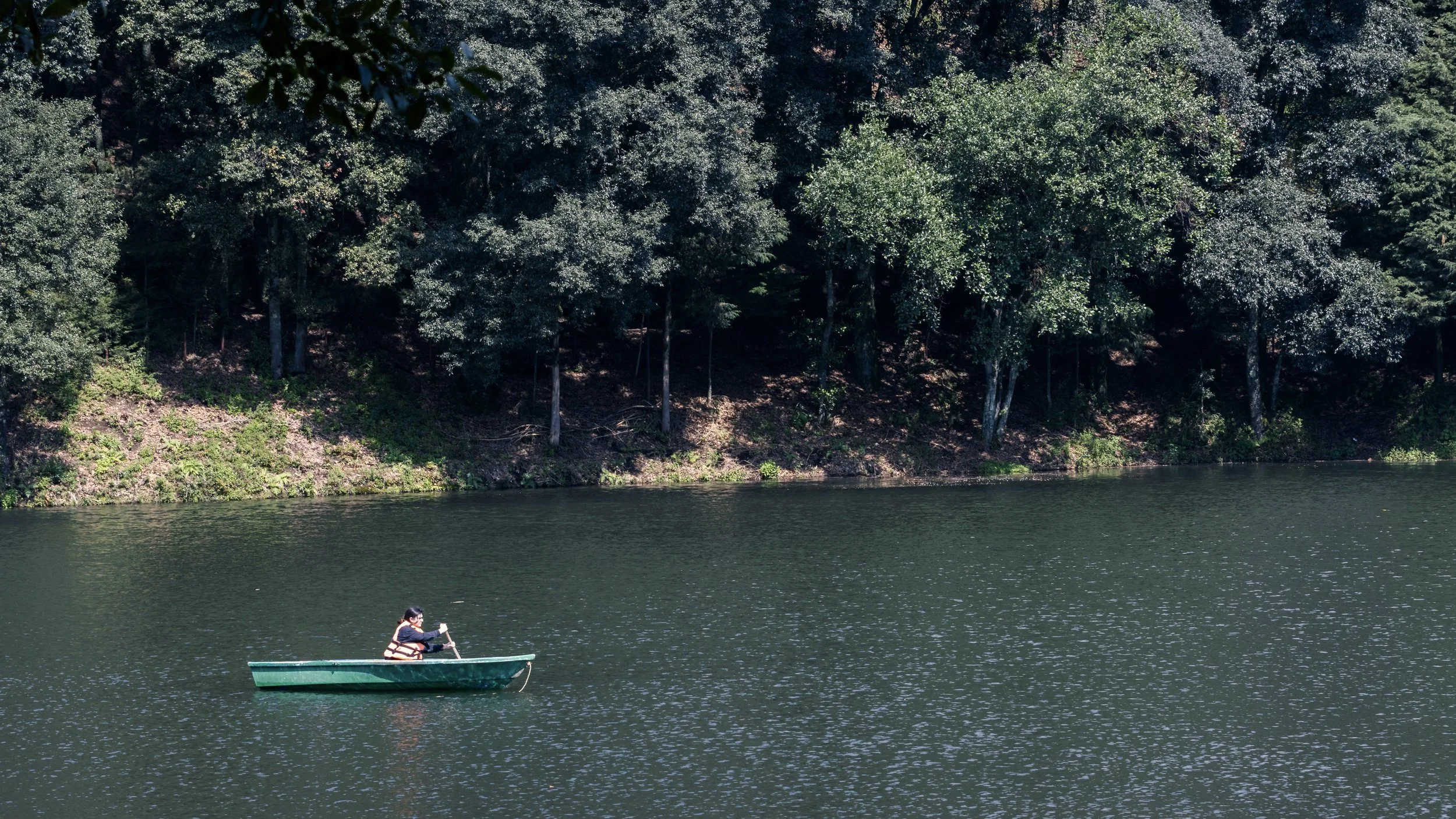
Photo credit: Roger Ce | Unsplash
Irene hadn’t heard the lifeguard shouting from the shore. She liked to turn her hearing aids off when she could, reveling in the artificial silence of the lake in summer. If she were alone, the way she’d be in the off-season, without all the tourists shouting and guffawing, scaring away the wildlife, she’d keep them turned up high enough to hear the bright per-chick-o-ree of the Goldfinch or maybe, if she were lucky, the tea-kettle, tea-kettle, tea-kettle tea of the Carolina Wren. But in the peak season, she’d have to contend with the crowds and the watchful eye of the lifeguard in order to get her morning exercise.
So she switched off the hearing aids as soon as she embarked from the adaptive canoe launch. A marvel, she thought. It used to be that she’d reluctantly talk to the park ranger or some nearby fisher, hoping they’d assist her with the fiberglass boat. Hoping she might remind them of their grandmother, her gray hair in a short-cut perm, a slight stoop to her shoulders from the years weighing down on her. But now she didn’t need to rely on the kindness of strangers like some broken-down Blanche DuBois. That, too, was a marvel.
Irene could see the lanky teen waving his suntanned arms in the air, the whistle dangling from his lips, his smooth cheeks puffed out. Her hearing might be going, but her eyesight was sharp. Sharp enough to spot the Great Blue Heron nest in the Weeping Willow on the far side of the lake without binoculars. And sharp enough to see that he wasn’t whistling for her afterall (few did these days–most paid her no mind at all), but rather for the boys rough-housing in the water, pushing each other under, maybe even daring one another to go beyond the buoys demarcating the swim zone.
Just the same, she’d wait until she had crested the slight bend in the oblong lake. There was no guarantee of privacy, of solitude, but the slight jut of land where an industrious muskrat had built up a den, a reedy nest of bulrushes, would provide some protection. It was far enough away from the designated swimming area and out of view from the hiking trails that switchbacked up the mountain.
As she paddled across the lake, the early morning sun already blistering, her thoughts eddied, rippling out. She hoped her granddaughter, Emma, had done as she had instructed: taken the Trailways down to the city to meet Shephard at the Port Authority Bus Station. He’d know how to take care of her from there. Hopefully he’d recognize her in the crowd of strangers after they had cut her long curls and smeared all that foundation make-up over her bruised face, like powdering dough with flour. He’d make it right, keep her safe. Shephard had always reminded Irene of a Killdeer, a protector on stilts with his long legs, even if his knees gave out once in a while nowadays. Yes, Emma was one thing Irene didn’t have to worry about now.
The algae was getting worse, just as Irene suspected. She’d been coming to the lake for sixty years and it had never been this bad. The beach had already closed five times this summer, the lake a sickening, toxic-sludge green, and it was only June. She peered into the water, murky like oversteeped tea. It’d close again, and soon. She only had to wait.
The lifeguard stalked the shoreline. He’d been trained well, she knew, having taught his trainer twenty years before. Lewis–or was it Kevin?–would have explained how often to sweep his gaze along the water’s surface, how often to climb down from his high chair and stretch his limbs to avoid cramping.
She checked her watch subtly as her arm raised to maneuver the oar. In a few minutes, he’d be replaced by another guard. She’d do it then. In the confusion of the shift change. When she was a young guard, that was when the boys would horseplay, testing her from the start, doubting her authority. But she’d blow her whistle and jerk her thumb to toss out the troublemakers. She was always good at that. Why should it be any different now?
Irene’s stomach growled, her insides twisting. She’d skipped dinner the night before, having known better than to eat the trout she’d prepared. Cutting around the skin ulcer marring its flesh, she had smothered it in an emulsified sauce to hide any hint of the toxic algae infecting it. Better than poison–too traceable. She learned that from the detective shows Emma had liked to watch growing up. Poison was too tricky to get it exactly right without getting caught. And though Irene longed to crack the man’s skull with the frying pan she’d seared the trout in, she knew Sheriff Conrad would have questions if he saw that.
She couldn’t be sloppy. She couldn’t be obvious. As thick-headed as the sheriff was–always harassing that nice Rios family at the farmers’ market, peeling open their corn and muttering, “Not the right color,” or bruising the peaches and not buying them–he could be sharp. Especially in an election year. That’s how she had decided on the toxic algae. Irene had watered down his precious beers with water from the lake too, in case frying the fish cooked off some of the toxins. It would be enough to make him sick and weak, maybe even kill him outright. The lake would do the rest.
Another lifeguard in red shorts and a tank top stretched across the sandy beach. Irene maneuvered the canoe beyond the muskrat den at the base of the willow, her head held high, pretending to watch the hungry Heron mouths yawn open, eager for food. Her arms were wiry and strong from years of canoeing, decades of swimming. She’d be sore the next day, but it was worth it as she pulled back the towel from the hull and lifted the body of her granddaughter’s abuser over the side. Shielding her eyes from the sun, her neck craned toward the bank as if birding, she kept a sharp sense of the dark jacket and mop of hair slipping beneath the water, the seaweed welcoming the body greedily.
She sat there a few minutes, letting the water rock her gently. A warm breeze rustled the willow strands, reminding her of Emma’s shorn locks. They were in a garbage bag now, along with the fish leftovers. She didn’t dare throw away any of his things, leaving a trail back to her. If anyone wondered, they’d think he’d moved on to the next dead-end job, to the next victim he could swindle and hurt, the way he had done with Emma. But Irene doubted anyone would miss him. She chanced a glance at the water before lifting the oar once more. The lifeguard sat in the high chair, scanning the swimmers. There was no commotion on the far bank, no one pointing in her direction. No one had seen her. They never did.
It would be a few days before his body floated to the surface. By that time, the cyanobacteria would multiply, the blue-ish green algae coating the water–and him. It might be a few more days before he’d be discovered. By then, Emma would go by some other name: Charlene, maybe, or Lark, after her favorite bird.
Paddling back towards shore, Irene made a plan to dig out her camera and try to take a photo of a Meadowlark in the grasslands of the nearby preserve. She’d keep it for Emma until it was safe, until the sheriff had given up investigating the death of a no-good man and chalked it up as an accident–a drunk drowning in a pond. She expected the sheriff would come and talk to her, ask her a few questions to make a show of doing his job. But she’d stoop her shoulders and answer vaguely, changing the subject to ask if he wanted more tea, and had he noticed how the mail carrier came later and later these days, and wasn’t that her tax dollars paying for his new cruiser? She could see the sheriff now, backing away from her, hat in hand, classifying her in his head as just a cantankerous old lady.
The Sheriff has no idea just how cantankerous.
As Irene pulled the canoe up the bank, she could almost hear the weet weet of a lark migrating home.
Editor’s Note
No spoilers, but I bet you will be fooled by the way Shelly Jones opens their story “Bloom.” An innocent birdwatching expedition, eh? I don’t think so. Jones uses the classic mystery trope of misdirection to make us think one thing about a character, and then turns that preconception on its head by revealing a completely different side of that same character. Because a good mystery tale needs characters that are, ahem, mysterious.
Josh Boldt, Editor
Story Track
Okay, bear with me on this one. As I read Shelly Jones’s “Bloom” I realized the plot reminded me of the song “Goodbye Earl” by The Chicks–right down to the method of disposal. As a teenager growing up in the South during the nineties, I heard The Chicks first albums a lot. Around here, there was even a bumper sticker about this song. Leave a comment on our social media if you remember what that bumper sticker said. Anyway, I loved the song back then, and I had just as much fun pulling it back out twenty-five years later. Oh, and Earl, those black-eyed peas tasted alright to me!