
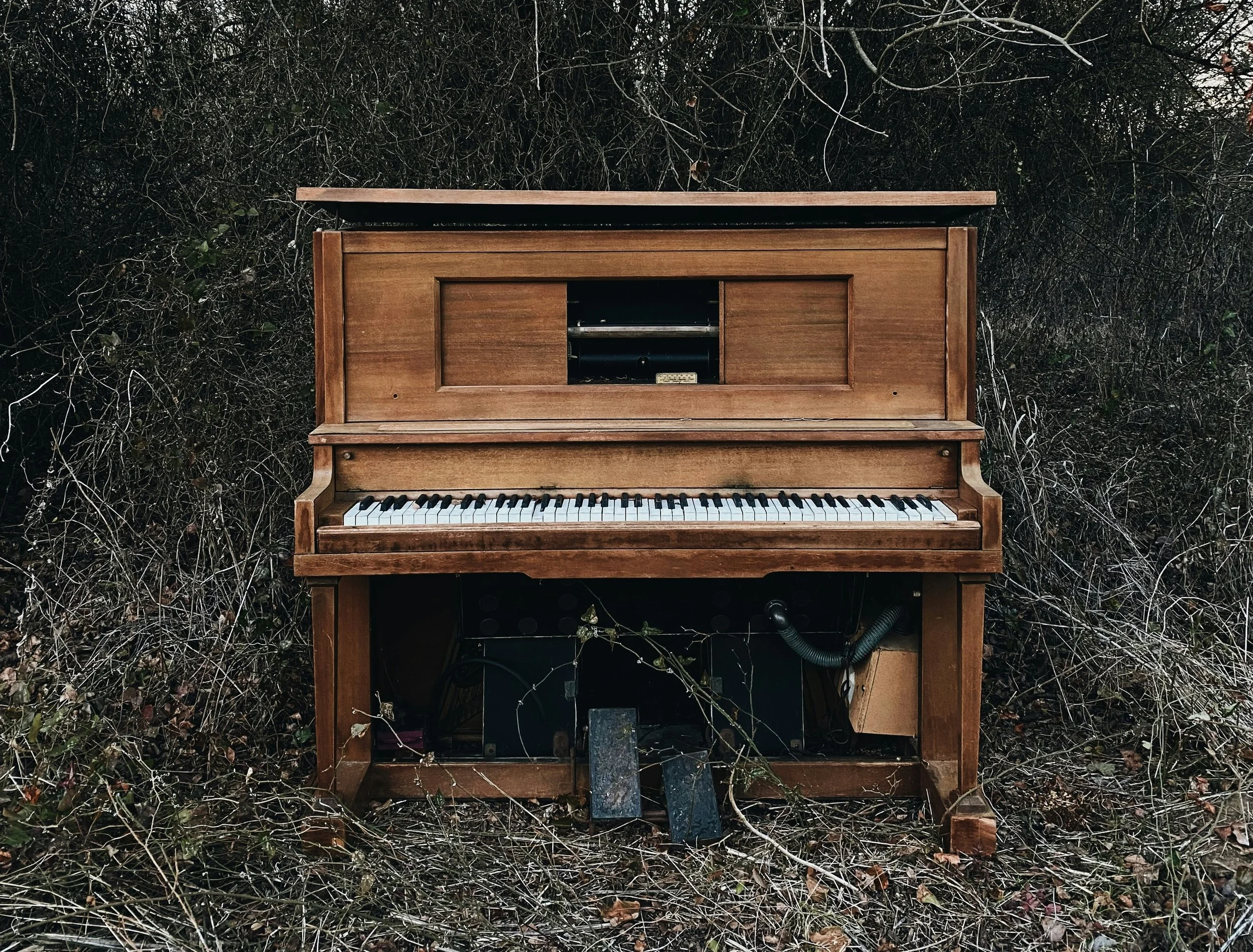
Photo credit: Morgan Von Gunten | Unsplash
Every so often, I would sit in the center of my apartment, cross-legged, and listen. I had tenants above and below me, and even though my landlord promised sound privacy, I’d lived in enough apartments to know there wasn’t such a thing. I listened, in part, as an ascetic exercise—a punishment for playing my piano late in the afternoons, which must have been grating to the neighbors.
After a while, I started logging the sounds I heard in a small notebook.
August 15th, 1998, 10:26 AM - The pattering of the upstairs Pomeranian’s feet as it skitters across the hardwood floors.
One afternoon, I was practicing the third movement of Beethoven’s Moonlight Sonata, a tough one to play quietly. In the four months I’d been in the apartment, I’d not had a single noise complaint. It was impossible for my neighbors not to have heard me, so I hoped they at least enjoyed it.
There was a knock at the door. It was an elderly man in a blue sport coat.
“Charlie?” he said. He held out both of his wrinkled hands, palms up, as if he were waiting for me to hand him something.
“Oh, I’m sorry,” I said. “You must have the wrong apartment. I’m Dan. It’s nice to meet you.” It was all I could think to say. I extended my hand to shake, but he seemed to be frozen in the palm-up position like a statue of the Virgin Mary.
“You…you have no idea how good it is to see you, Charlie,” he said. “The sonata sounds beautiful.”
“No,” I said. “I’m Daniel. Do you live in this building?” The way he stood there with his watery eyes made me feel like I’d done something wrong. Like not being Charlie was a selfish decision. He just stared, and finally, I invited him in. He seemed harmless enough.
I asked the man if he wanted anything to drink. Bourbon? Coffee? Tea? Water? A beer? He declined it all. I asked him his name, and he just laughed.
“I’m your Papà, Charlie. Play the Beethoven, it sounded beautiful.”
I knew the longer I played into it, the worse it would get. My sister and I had plenty of long nights sitting with our mom, pretending to be people we weren’t so not to upset her. But what was I supposed to do? Ask the man to leave? Call the cops? Walk him back to his unit? I didn’t even know where he lived. So I played. I started with the first movement.
“Ah, yes,” I heard him say to himself. He continued his commentary the whole way through. “Yes, perfect tempo,” he said at one point. “Excellent dynamics and voicing. Wonderful, wonderful, wonderful, but the piano needs tuning.”
October 4th, 1998, 05:16 PM - The young couple next door talking loudly while opening and closing cabinets.
I continued into the second movement—the one my music teacher in college told me no one cared about—and the old man swayed back and forth on the couch like a blade of grass in a storm. “You learned part two,” he said. “Very, very good. Benny used to play part two. It was the only part he could play. Did Benny teach you this?”
“No,” I said. “I picked it up on my own.”
“I haven’t heard from Benny in so long. Benny used to have that funny way about him where he would look right over your shoulder when you were talking to him. Always made you feel like he was looking at someone right behind you instead of listening, but when you turned around, no one was ever there. Benny was an odd bird.”
How, exactly, was I supposed to wrap it up? He was clearly starved for attention. “Do you want part three before you go?” I said.
“Trying to get rid of me so soon? You are always so rushed, Charlie. Yes, I want to hear part three.”
After finishing the third movement, I walked over to the couch and extended my hand. “Let me help you up,” I said. “It’s getting late. You need to go home.”
“I can get up perfectly well on my own,” he said, brushing away my hand. “I might be 90, but you know I’ve got the energy of a 70-year-old.” He stood up cautiously, pushing himself upward with his hands on the couch cushions. Once standing, he stumbled toward me for a hug.
“Alright,” I said, hugging him and patting his back. “Let’s get you home.”
He was a slow walker, and halfway down the hallway, he stopped and turned to me. “Why…what are you doing living in my building, Charlie?”
“Let’s get you home, I said.”
He stood, frozen, in the middle of the hall for a moment. “Come on,” I said. “Let’s get going. Where do you live?”
“Just walk me to the stairs and I’ll make it the rest of the way.”
“Are you sure?” I said. “I don’t want you to fall.”
“How many times do I have to tell you?” he said, turning to me and lifting a finger. “I can handle a few stairs by myself. I made it through the war. I can make it through this building.”
I let him go and went back to the apartment to get some sleep.
October 11th, 1998, 9:30 PM - A loud crack followed by a hiss from under the floorboards in my bedroom.
It was a week before I saw him again—Debussy’s Rêverie got his attention. When I’d finished playing, there was another knock at the door. I knew it was him before I opened it.
“Debussy,” he said. “Since when did you start playing Debussy? I thought I’d taught you better.” He made his way in without asking and went to the piano. He placed a small, leather bag on the stool, and opened it to reveal a set of tuning instruments.
“No tuning in the world could fix Debussy,” he said, “but I’d be a lousy Papà if I didn’t try.” He toiled away for about an hour while I made and ate my microwave dinner and then started a pot of coffee. When he finished, he was sweating.
“Coffee?” I said.
“Since when have I drank coffee? I’ll have some cucumber water.”
I poured him some lukewarm tap water into a mug with a cactus on it.
“Perfetto,” he said after draining the whole thing in one go. “You know just how I like it. Well, why don’t you take it for a ride?” His hand was extended toward the piano. “Maybe something less French?”
I played Bach’s Prelude in C Major, not knowing how he would react, and was glad to see him close his eyes and smile. The piano sounded noticeably better, like a film had been lifted off the strings.
“What do I owe you?” I said, before catching myself.
“Don’t mess around,” he said. “Just get back to the Bach.”
I was taking advantage of the situation. Having a professional, of which I had no doubt he was, tune a piano wasn’t cheap. I’d received a family discount for a family I wasn’t a part of.
“Let me just give you a little something to spend on groceries,” I said, fishing a twenty out of my wallet and handing it over. He took the bill, folded it into a small triangle, and sat it on the back of the piano—a little green boat on a charcoal ocean.
“Why don’t you play me a song?” I said.
“You know I don’t play, Charlie. It’s getting late, maybe you should give me a ride home.
After reminding the man a car ride wouldn’t be necessary, we took another trip down the hall, and at almost the same spot as a week earlier, he stopped and said he would find his own way home. I listened for a while as he sauntered down the steps, occasionally stopping for brief moments in his descent, maybe to catch his breath. When he made it to the bottom, I gave him a short head start and followed. Wherever he had gone, he had gone quickly—like he’d scurried down the steps and collapsed back into nothing.
November 3rd, 1998, 8:12 AM - The low, steady growl of the heater like a disoriented animal.
I spent the next few weeks waiting for him to come back. I tried to summon him with songs I thought he would either love or hate. More Beethoven, more Debussy, Mozart, Liszt, Chopin, Ravel, Satie, Fauré, the little I could manage of Rachmaninoff. I even improvised some jazz; surely he’d have an opinion on jazz. Did his son ever play jazz—his real one? Did he even have a son? Surely he did. Surely I reminded him of whatever real son he had out there—that in his senile haze, he couldn’t keep the small details clear anymore and he looked for love, or familiarity, wherever he could find it.
I kept him to myself for a long time—a secret I flipped back and forth from being true to being a dream when I was tired or drunk enough to blur the reality for myself. But whenever I came back to my right, awake, attentive mind, I knew I had met the man just like I knew I had graduated college and I knew I had moved to Nashville in some sad attempt at making a living for myself as a musician.
Whenever I played the piano, I wondered if he was listening. I wondered if he realized the mistake he had made—if there had been some lapse in his dementia, maybe triggered by his real son calling or visiting. I wondered if the two of them had laughed about the misunderstanding. If he was avoiding me out of shame or embarrassment. Once, I wrote in my notebook that I heard him approaching the door to see if I could will it to happen through some kind of mystical transcription. That, of course, didn’t work.
April 1st, 1999, 10:30 PM - Two cats fighting over some trash out by the dumpster.
Mom had been my biggest supporter when she was well. She encouraged me to move to Nashville when most of my friends had mocked me for even considering it. “You know your chances of making it in music are as good as getting hit by a train,” one of them had said. Surely, they didn’t realize the strength of the pull when you knew exactly what it was you were meant for. Having a real vocation is less common than people think.
Mom knew, though. She had been a receptionist at a dentist’s office before having me and my sister, and then she took up a second job at a store that sold gift cards and knickknacks to afford to feed us. She had never had a vocation. Maybe that’s why she supported mine.
I’d mentioned in passing to her one day that I needed to find a way to get my cat to Nashville without him panicking the whole drive. “Why are you going to Nashville?” she’d said. That was the start of it.
Eventually she needed full-time care, and when I’d come back home to visit, she didn’t recognize me anymore. I made the trip every weekend, and at points, I questioned why I was doing it. I wasn’t visiting my mom anymore. I was as good as a stranger to her. But each time I went, there was a part of me that hoped she would perk up—that her eyes would shift in that way they so rarely did and she would say my name.
A few years later, I moved into a house where I could play my piano without worrying about neighbors. Still, I couldn’t shake the habit of writing down what I heard. Wherever I went, sounds disrupted my privacy. Sounds I had to capture in ink.
May 17th, 2002, 8:09 PM - Muffled voices from somewhere in the neighborhood.
When Mom was at her weakest, I traveled home to stay with her and my sister, getting to know the hospice nurses by name and regularly reminding them how they should interact with an Alzheimer’s patient. It never ceased to amaze me how little they knew about etiquette and proper care when it was their profession.
One night, my sister came out of the master bedroom that our mother was confined to and brushed past me in the hallway. “She’s asking for Charlie,” she said. “That’s a new one. Any idea who that could be?”
I pulled a flimsy wooden chair up to Mom’s bedside, and took her hand in mine.
“Charlie,” she said.
“I’m right here,” I said. “It’s me, Daniel.”
“Were you playing the sonata? Play me the sonata.”
As supportive as she had always been, she had never asked me for music—she didn’t even have a piano. It came to me slowly as if rising from the muck of a swamp—the memory of the man coming into my apartment, the way he looked at me with such admiration and familiarity. I held Mom’s hand tighter. “Please rest,” I said, and as I pressed down on the hands that had dressed me and bathed me when I was a child, now cold and skeletal, I noticed a creaking in the bedroom walls. Maybe animals had made their way in, but it was probably just the wind.
Editor’s Note
Gather ‘round, dear Brown Hound readers, for it’s time for the Halloween week story. Nicholas Bacci Siegel’s “Sound Privacy” is a subtly haunting tale about a mysterious visitor who shows up at a man’s apartment requesting piano music. Is the visitor real or is he a ghost? And how does this experience with a musical visitor reach across the spectral plane to touch the man’s relationship with his own mother? Read on if you dare…
Josh Boldt, Editor
Story Track
Classical music is a bit of blind spot in my catalog. It’s something I need to learn more about, so thank you to Nicholas Bacci Siegel’s “Sound Privacy” for the introduction to Mozart’s “Moonlight Sonata.” From the moment the song began I instantly knew why Siegel chose it as the piece Daniel plays to conjure his mysterious visitor. The first movement is the perfect soundtrack for such a ghost story.
Josh Boldt, Editor