
The Pantry
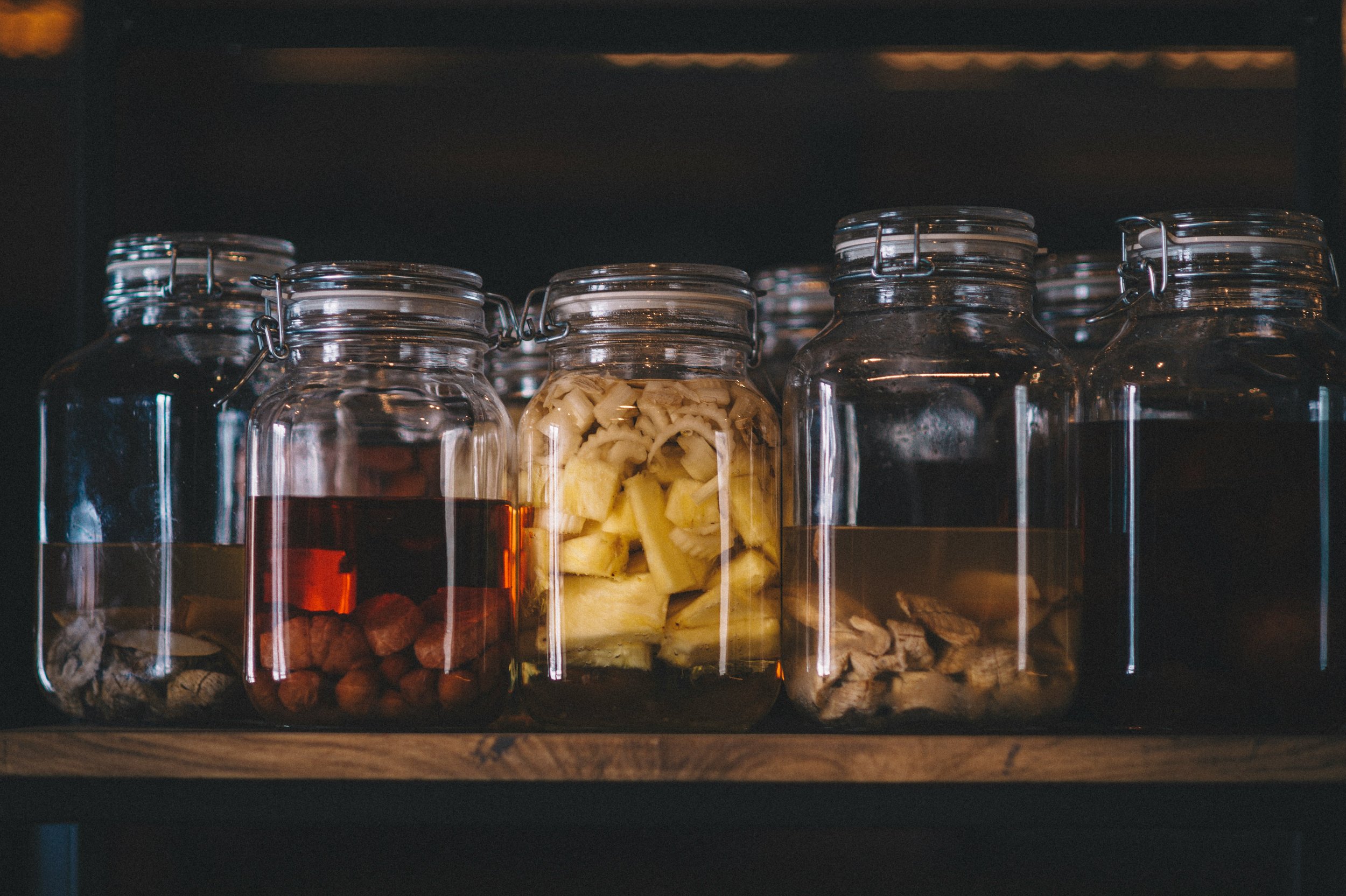
Emily carefully set the last jar on the shelf, watching the collagen-thick bone broth quiver in the pantry’s dim light. She ran her fingers along each neatly labeled jar; bone broth in beef and chicken, green beans and red tomatoes like Christmas decorations. Some of the women in the Canning Club used jars they traded or bought at the ReUse Center, but that meant they weren’t uniform.
The uniformity was key. It allowed her to plan, form straight lines on all her shelves, to know what she had without worrying whether she was missing a jar that might be stashed behind the others. A jar of basil pesto that was too squat or asparagus that was too tall might be the difference between life and death during the Storm.
Of course, the other women didn’t see it that way. They canned because it was fun. They brought wine and crackers to the community kitchen, played dance music from their phones, laughed as they swapped cinnamon applesauce and syrupy pears. Their gardens were for fun, to shave a few dollars off their grocery bills. They didn’t know about the coming Storm. She tried to tell them of the waters that would rise around their unforgiven souls, invited them to her church services and her living room Bible study to get their spiritual life vests, but they just brushed her off.
She didn’t want the Canning Club ladies to drown in the waters of God’s justice. They were kind to her. They were funny. Cora, the leader of the group, was generous and practical, listened to punk music and had a silver stud by her nose that she called a Monroe piercing. She wore an apron she made out of an oversized Madonna t-shirt that reminded Emily of the one her roommate wore in college. That was before Emily became engaged to her husband, Aaron, and dropped out to build the homestead that would be their shelter from the Storm.
None of Cora’s jars ever fit in the pantry, but she insisted Emily take some of her peaches, the same ones that she won awards for at the state fair. She didn’t even ask for a trade. Aaron, meanwhile, insisted on locking them in the medicine cabinet. They’re probably poisoned, he said. We’ll eat them when we run out of everything else, when it’s time to join our Brother Christ in Heaven. None of the other women ever seemed bothered by Cora’s peaches, but there was no sense taking a risk–not for her or for the baby.
She rubbed her belly. The women of Canning Club gave her recipes for homemade baby food, brought her hand-me-downs and crocheted blankets. Cora even made one from a Beauty and the Beast shirt because Emily mentioned it was her favorite Disney movie when she was little. She hid all of their gifts in a little suitcase, a go-bag ready for the baby, for when they needed to get into the homestead. Aaron couldn’t argue with them there. For the forty days that the lock would hold, he could just deal with a little blasphemy. She wanted the memory of her friends to remain alive long after they were gone.
The baby kicked. Shh, baby baby, Emily sang. She wanted to name the baby Amy, like Amy Grant, but Aaron insisted on naming her Rachael. She called her Amy in her mind. She was the one who was carrying her, after all. In a few weeks, she would be Rachael, but for now, she was Amy.
Emily locked the pantry cabinet and hung the key around her neck. She would never tell Aaron, but the homestead terrified her. The metal door at the top of the stairs locked on a timer that wouldn't open for forty days, and because of that, they could never fully close the outside door. Any little sound, any creak of wind and she was sure the rock holding open the sliver of light would falter, trapping her inside without her husband, without her cell phone, without any way to cry for help when the baby came.
Some days as she listened to the Reverend Barnaby’s sermons, she imagined herself staying behind and letting the storm take her, like Dorothy into Oz. They had more than enough in the pantry to last them a year, even with a growing baby, but the thought of spending that much time underground–even with a bed, a kitchenette, and the pantry–was a miserable one. But then Amy would kick, and Emily would come back to herself. Forty days until the New Dawn, and then they would step out into a reborn world. That much, she told herself, was worth waiting for.
She locked the pantry door and climbed the stairs. She was relieved to take a deep breath of fresh air and see the sunlight, even if it was beginning to slip down beneath the orchard trees. It was only a hundred yards or so between the homestead and the house, but it felt like she was leaving the whole world behind.
Aaron spotted her and came over from the barn. She had asked him what would happen to the chickens and the cattle during the storm, and all he told her was that the Lord would provide for his flock. He kissed her head, smelling of hay and mud and manure. She tried not to recoil. “How are my girls?” he asked.
“She’s feisty today,” she replied. “I swear, she’s learning to dance.”
He laughed. He cupped her belly in his hands. “You need to stop that,” he teased. “Dancing is a sin, my dear, we’ve talked about this. You need to slow those little tapping feet of yours and give your mother a rest.”
Emily struggled to sit through Rev. Barnaby’s evening services. More like Reverend Barnacle, she’d once joked. Aaron didn’t find it funny, but she still thought of it every time the reverend stood at the pulpit with his old pirate beard and his heavy white eyebrows. This had not always been her church–her father’s AA sponsor, Aaron’s uncle Bruce, had been a member–so when she and Aaron got married, she was given over from her family’s branch of the congregation to his in a ceremony with white flowers and sheet cake.
She wondered if her family was preparing for the Storm the same way they were. Aaron’s parents had died a few years back, leaving them the farmhouse and the homestead, the same one his grandfather had built when the fear of God was surpassed by the fear of The Bomb.
She’d been afraid of the Storm since she was a child. Everything felt normal until one day, when her father came home and told her what his sponsor had told him. It seemed like there was always a storm; first her father’s drinking, then this Storm, the one he promised would wipe all the sins from the world. It was easier to repent loudly from the pew than to make quiet amends in the home. He never apologized for the bruises he left, the dolls he tore up, the nights that Emily and her mother went hungry while he vomited up the liquor he’d spent the grocery money on.
When Emily was younger, she used to sin in hopes that the Storm might take her when it hit. She would whisper curse words, steal candy, gossip. She listened to the radio on headphones a friend had given her, imagining a world where she could bare her belly and sing about sex. But then she met Aaron, and he made her want to be saved. Now, she had to live for Amy.
Rachael.
Disobeying or arguing with her husband was a sin. If he wanted to name the baby Rachael, they were going to name the baby Rachael. She had to get used to that. Had to practice. Rachael, Rachael, Rachael.
But Emily didn’t want to hear about the Storm tonight. She didn’t want to hear about the sins of the world she was bringing her baby into. She wanted to imagine a world like Cora and the others lived in; bright and warm, full of laughter and music and sweets. She stroked her belly and bit back tears.
Emily waited in the car while Aaron met with the other men of the group for their guided prayers. Some women liked to get together in the social hall and chat, but Emily wasn’t in a chatty mood. She just wanted to go home, mix up a little baking soda in water to settle her tummy, and crawl into bed with a cold towel. Her skin was clammy. Her back hurt. She tried to sit outside, but the heavy air did nothing to cool her feverish head.
Aaron was smiling when he emerged. “All is well,” he said. “The Lord provides.”
The ride home was quiet until they pulled into the long driveway up to the farmhouse. The entrance to the homestead loomed past the headlights like a tomb.
“Are we doing the right thing?” she asked. “Bringing a baby into this terrible world?”
“We absolutely are,” he said, patting her hand. “The Storm is coming soon, and when it passes, it’ll be a dawn like you’ve never seen. That’s the world we’re bringing Rachael into.”
The lightning woke Emily. Aaron was already awake, grinning like his whole face might split. “This is it,” he said as he grabbed their bags from the closet. “This is it. Rev. Barnaby told us it was coming soon. The creek is rising and the Lord is coming to carry his flock across the waters.”
Emily got up and put on her robe, went into the hallway to get her phone from where it was charging on the side table. No club tomorrow, Cora had written in the Canning Club group chat half an hour earlier. Tornado warning coming through.
Good excuse to eat cherry pie filling right out of the jar, Bonnie wrote.
Is this what Aaron and the others had stayed after to talk about? She had seen the weather warning days ago, pitching from a few showers to a spring rain to these winds and water that pounded on the hallway windows. “Maybe it’s just a thunderstorm,” she said, reaching for his arm to try and slow him down. “We can get down in the basement if you want, but we don’t need the bags. It looks like it’ll pass in a few hours.”
He stopped and stared at her. “Don’t you believe?” he asked.
“Of course I believe,” she said. “But I’m scared of getting trapped for two months while the rain clears up in a day or so. What about the chickens? Who will feed and milk the cows?”
“Don’t argue with me,” he said. “I am your husband, I have asked the Lord for his guidance and He has told me that this is it. Get dressed and come on. There isn’t much time left.”
Emily didn’t budge. “God didn’t tell me anything,” she said. “But the girls said it was coming through, that’s why there’s no Canning Club tomorrow. They were worried the bridge might get washed out….”
“Those girls are evil!” he hollered over the rain pounding on the roof. “They are the spawn of Eve and the snake, can’t you see that? That’s why God doesn’t talk to you, because he knows your head is filled with lies!”
Anger filled her mouth like wasps. “They’re not evil!” she insisted. “They’re my friends and I pray for them every day! God loves them as much as He loves anybody!”
And then lightning struck. It filled her belly, down through her thighs, flushing rainwater through her nightgown. She sank to the floor, sobbing. “The baby,” she gasped. “The baby is coming.”
“No,” Aaron said. “No, no, no. Not now, damn it!”
Was this her punishment for disobeying her husband, as the pains of birth were Eve’s punishment for disobeying God’s singular commandment? The lightning struck again, inside and outside as the lights above the hallway went dark. “Aaron please!” she shrieked. “Get me into the bathroom, please. We’ll be safe there, I promise.”
He backed toward the doorway. He dropped her bag. “This is what happens when you conspire with serpents,” he said. “I won’t have my baby born in sin!”
She tried to argue, but all that came out was a groan like a demon rising in her throat. She lurched forward, spit out bile that burned on her tongue and lips. He threw open the door and she tried to stumble after him. “Aaron…” she pleaded. “Where are you going?”
“The homestead,” he said. “This is a test. If you’re still here when I emerge, I’ll know you are truly pure.”
“Aaron, don’t!”
He didn’t hear her. He vanished into the rain. Was he really going to leave her alone to give birth on the floor, unassisted, unclean? The lightning came again and she crumpled to the floor, crawling on all fours back to where she’d left her phone. Aaron left, she wrote in the Canning Club chain. Baby coming, Please help.
She tried to pray. Heavenly Father, please protect my baby. Please let her be safe, please help me, Lord, in this dark hour. If this was the prophesized Storm, then God wouldn’t hear her. There were so many ways she could die. The house could catch fire, the rising creek could drown her, the baby’s arrival could bleed her to death.
She crawled to the kitchen. She had just mopped it yesterday; it was the cleanest floor in the house. She pulled out dish towels, her apron. She tried to remember how to breathe through the pain. Eve gave birth to Cain and Abel in the dirt of Eden. Mary gave birth to Jesus in a manger among cattle. Her mother gave birth to her on the shag carpet of their double-wide trailer. Things were already looking up for her.
Her phone buzzed. She reached for it. On our way, Cora wrote. You just hang in there.
They were coming for her, like angels, braving the Storm to protect her. She kissed the phone. God may not have heard her prayers, but her friends did. As darkness closed in along the edges of her vision, that was all that mattered.
She didn’t know how long she was unconscious, but when she woke up, Bonnie was cradling her. “Almost there, mama,” she cooed, wiping her brow. “You’re doing good.”
Cora sat between her thighs. “My mother was a maternity ward nurse,” she said. “And both my babies were home births. You’re safe, no complications. You keep pushing, and this little one will be right along.”
“The Storm…” she gasped. “What about the flood? The fire?”
“It’s still raining,” said Joanne. “But the creek didn’t come over the bridge.”
“And no fires as far as we can see,” Louise added. “If you hear sirens, that’s because we called an ambulance for backup, just in case.”
But the lightning remained. Emily pushed against it, squeezed the hands in hers, let it all go with one last rush of strength and agony.
And then, a baby’s cry.
“She’s a girl,” Cora said. “And a big one too.”
“A girl…” she breathed. “My baby girl….”
Cora placed the baby in her arms. She opened her blouse, pressed the infant’s skin to hers, guided her mouth towards her milk-swollen breast.
And there, resting on her sternum, just above the baby, was the necklace that held the pantry key.
When the EMTs arrived, they might hear Aaron pounding on the door, pleading to be let out. But there was nothing that could be done unless they brought in heavy machinery and dug him out like an old septic tank. That door would stay locked for forty days, as prophesized. Forty days from now, the latch would release and the police would find him dead of hunger, withered from thirst. All of her jars would still be neatly stacked, safe from thieves.
The baby’s mouth found her nipple. She began to suckle. Emily felt a rush of love. Was this the Rapture? Did Mary feel this way when she placed Jesus in the manger? She must have. No man could ever give her love like this. Not Aaron, not Christ, not God in all His glory. The other women, they knew these divine secrets, these whispers coded and passed down along Eve’s bloodline.
And now, with her baby in her arms, she knew them too.
“What is her name?” Cora asked.
“Amy,” she said softly. “Her name is Amy.”
Editor’s Note
Libby Cudmore’s “The Pantry” was the first story I purchased for Brown Hound. I love a southern gothic vibe. Mix in a fanatical prophet and a narrator who is struggling to bridge the gap between cultural ideology and her own moral awakening, and I was hooked. I had to know how things would turn out for Emily. Could she overcome the corrosive influence of her husband’s church and rechart the future of her family?
____
If you had a pulse in the 1990s then you remember the Jar of Flies album from Alice in Chains. “Rotten Apple” leads off the record. Not only does the song’s tone match the story, but so do lyrics like “arrogance is potent” and “sustenance is stolen.” Then there’s the whole canning jar connection. This song hit me like a strike of Emily’s lightning–I’d picked it for the story before I even finished reading.
-Josh Boldt, Editor