
Bila
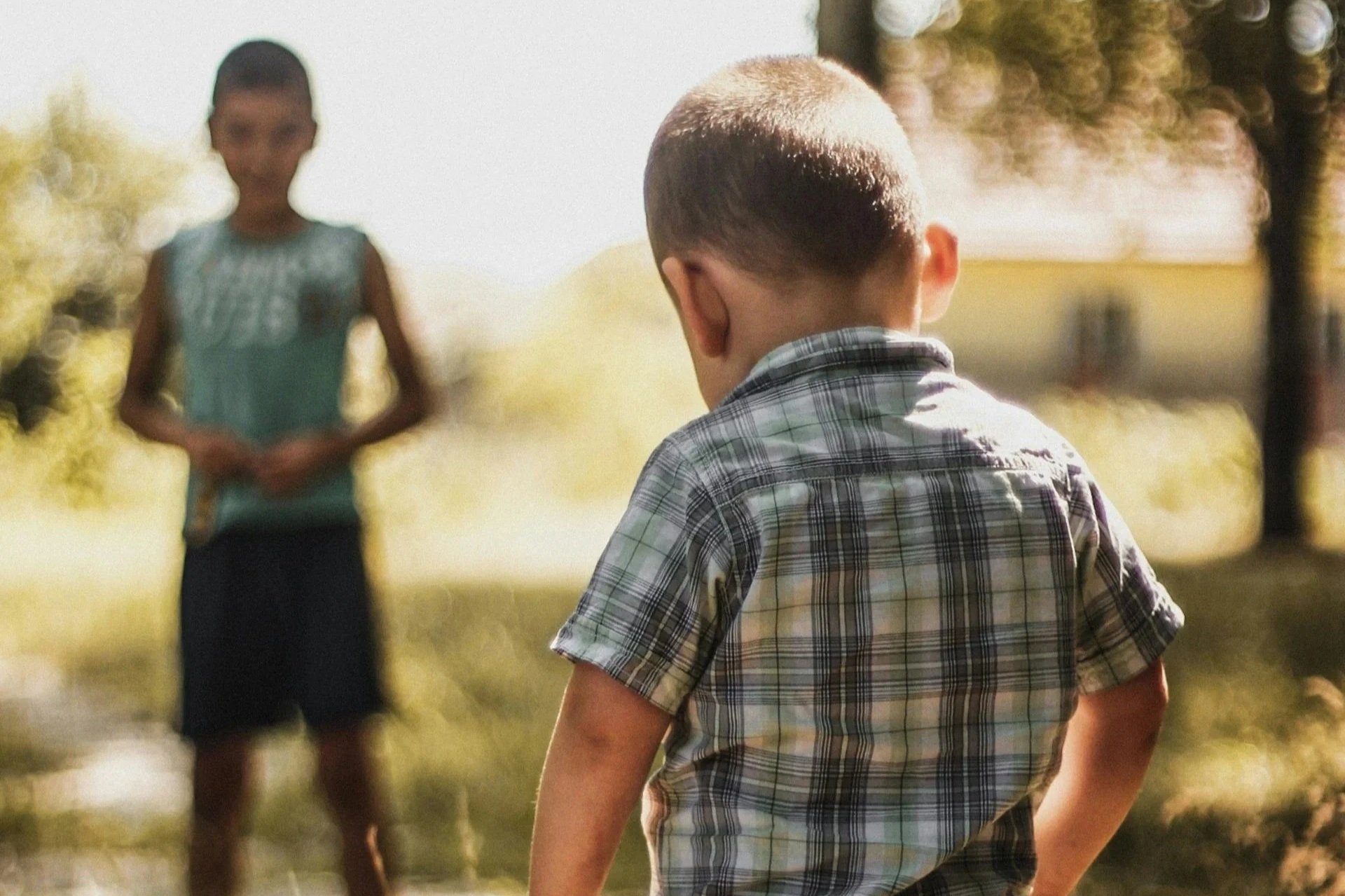
Photo credit: Rashid Sadykov / Unsplash
It is after we try the charts with the stars, the timeouts, the “ignore and isolate” strategy, that we tell Sila about our other son, Bila.
Bila, we say, is our first son. He’s your brother.
My brother?
Yes. He lives in the backyard now. In the hedges. And he can never come inside.
Why can’t he come inside, Sila wants to know.
Well honey, we say, he was so bad, just a bad boy. We made him sleep outside until he straightened up.
Did he? Did he straighten up?
Oh yes, he was the best kid we could ask for. He never spat on people, or hit his mommy, or pulled out all the food from the refrigerator, or hid from us at Target. He never cried over the TV, we say. And he would never ever dream of hitting the girls in class.
Sila thinks about this for a second. He chews on his lower lip, which is raw and scabbed despite our efforts. Don’t pick at your lip, we tell him.
Then why isn’t he back in the house? Why can’t we play?
We had you, we say.
Me?
We say, yes, we told Bila that he had to straighten up before you were born or he would never be allowed back inside. We’d have a new son then. One who was much nicer and well-behaved.
And he didn’t listen?
No, we said. It was only after you were born that his attitude changed. Because, we went on, if you ever get as bad as him, we told him that he could take your place.
Finally, that does it. Clear, pure, fresh tears of a five-year-old. They run down his cheek and neck, soak his shirt. He always cries with his face up, mouth open.
We leave him there on his bed to think about it.
Before dinner we check on him. His face is red and pancaked to the wall. He has cried himself to sleep. We pull him down onto his bed, peel off his wet shirt and then his pants, and leave him in his underwear, blanket covering him, and the fan blowing to keep him cool.
Five is hard, we agree.
We are so pleased when Sila brings home a note from his teacher about his good behavior.
We take him to Cheeky Ratbags, the pizza and arcade games place. We even let him play in the ballpit, knowing full well the risk of pink eye or strep throat or being stabbed with a junkie’s discarded hypodermic needle.
The rat, Cheeky, a high schooler wearing a large rathead with matted, fake fur and a silver, long sleeve t-shirt under a blue, short sleeve tee with a large crooked R ironed on the front, wobbles around pantomiming emotion. For some inexplicable reason, the eyes are knocked inward and up, so that the rat looks a bit crazed or mentally deficient. He’s got one crooked tooth and a hoop in the belt of his pants to distend his belly. He, the rat, looks like he plays too many computer games.
In the past, we’ve gone as far as boycotting every birthday invitation we receive that says little So-and-So’s birthday party will be hosted here. The invite always comes with the cartoon caricature of the real-life mascot. Cheeky Ratbag’s left shoe string is always untied. Sila would carry around the invitations, knocking into walls and crossing his eyes.
We had decided to wait to discuss the form that the school psychologist had sent along with the teacher’s note, but we agree, under the yellow light of the hanging buffet lamps, as Sila stuffs his cheeks full of cheese ripped from several slices of pizza, that it is probably nothing to be worried about.
Sila crosses his eyes and asks us to watch him squeeze out the compacted cheese from his cheeks. It squeaks along his teeth before landing just shy of the table in a greasy spit soaked wad on his lap.
He’s just a kid, we say.
At the start of spring break we throw a party. Friends from around the neighborhood. Bring a side item. There’s a few kids Sila’s age, a few a bit older, and their parents. We grill kabobs and drink. The kids play in the backyard, around the hedges. It’s hot, but not so hot that the mosquitos are unbearable. We slap them away. Spilled liquor evaporates quickly.
The Hantles are divorcing. Married for three years with a little girl. Actually, it’s the Boone and Hantles—she never took his last name. Never wore the ring either. We agree that he is both an idiot and too good for her. But the women also agree that they would never want to be married to him.
We want to know about the first grade teachers. Darby Tappet is on the PTA and has had three kids go through Maxwell Elementary; her youngest is in the third grade. She makes a show of saying we can’t go wrong with any of the teachers, but this is the public school we are talking about. She wants to be asked who her three boys had, so we ask her. It was Mrs. Camton.
Not because she’s the best, she’s quick to say. My boys just had a special bond with her. Darby Tappet takes her elected position on the PTA very seriously, even though we all know she’s full of it. Mrs. Camton is the best first grade teacher at Maxwell.
The kids come shrieking over to the patio jumping around, finding their parents and yelling in their faces.
Whoa, now. Everyone calm down. Stop speaking all at once, we say.
We nominate Stacey, the oldest of the children, to speak on behalf of the rest. Her mom tells her that all the yelling is giving her a headache.
Stacey speaks softly.
We were over playing in the hedges, some stupid game that Sila made up called Bila in the Bushes. Stacey takes an elaborate and staged pause. Stacey does drama in the community children’s theater. Then, she says, Sila told us he found Bila and then he climbed under the fence and won’t answer when we say his name.
I’m sure he will come back over when he’s ready.
We’ve been trying foooreeeever, the Wards’ kid says.
We are a little embarrassed. We’d been telling everyone how Sila had turned his behavior around, a complete one-eighty, we had said.
We tell the children to go play and Sila would come out when he was ready.
We confess to the adults about Bila. We laugh about how well it seemed to be working out. And when Lindsay Shavel says that you shouldn’t threaten a child unless you are going to follow through, we feel a little ashamed, but she can take her essential oil, homebirth, anti-vax opinions and shove them up her ass.
We are a bit drunk.
We say something like, at this point we are just going with whatever works.
Lindsay Shavel says, I understand, parenting is very personal.
Darby Tappet leans in conspiratorially but whispering loudly enough that everyone can hear, just as she intends, and asks us, did you ever hear back from the school psychologist? You know? Did anything come of the form you asked me about?
The kids start yelling Sila’s name at the top of their lungs.
We make a mental note to never tell Darby Tappet anything else, ever again.
We walk over to the hedgeline and yell over. Sila, if we have to go knock on Mr. Beager’s door, you’re going to be in big trouble. We recognize that Lindsay Shavel would say that this is a threat, but there’s wiggle room in the word “big.”
Sila does not respond.
Sila. We raise our voice. You can forget about going to Cheeky Ratbags ever again. And, we say, every minute you take to follow directions, we’re going to take a toy for a week.
We wait, counting the seconds in our heads.
Sila emerges at fifty seconds.
The principal’s office is off-putting, we think. There’s only one piece of artwork, which strikes us as odd. This is an elementary school after all. There are no photographs. The cabinets are a sterile blue with white plastic handles. Some books on how to be a good leader sit on a shelf with integrity but not much use.
The principal’s name is Dr. Dean. He introduces us to the school psychologist, a Patty Beedpin.
Thank you all for coming in today, Principal Dean says.
We were happy to, we say.
Then principal Dean says, Patt, would you like to give us a rundown of why we’ve asked the McClure’s to come in today.
Patty has a suffocatingly polite voice. Her speech is slow and deliberate, as if we are the children and she the adult.
Mr. and Mrs. McClure, she says. We wanted to let you know, she says, that your son, Sila McClure, has been telling his teacher and other students that you make him sleep outside in the hedges.
We exchange a look, but Ms. Patty Beedpin continues on, enunciating each word carefully, like she’s building a tower out of children’s toys that we could knock over at any second.
This isn’t alarming by itself, actually quite typical for this age, but—she pauses for a moment for emphasis—he also requested to be called Bila.
Dr. Dean nods along in a practiced and impenetrable way.
She lets that sink in, seeing if it has any special meaning to us.
It has no special meaning to us.
She says, it’s our policy to talk with parents before agreeing to such a request.
We wait to see if she is finished.
It’s just that, she clears her throat. We usually like to honor what our students ask us to do; it helps them with their independence and identity.
His name is Sila, we say.
Right, of course, she says, like somehow we missed the point of what she had painstakingly laid out for us. She looks at Dr. Dean.
The principal appears to have lost interest in the conversation. He stares at us blankly, blinking heavily.
The psychologist scoots forward in her seat. She says, I had Sila in my office earlier today and we talked about him wanting to change his name. What alarmed me is that he claimed to have never been Sila, and when asked, said that he had no memories of the school, the teachers, or even his friends.
We shift in our seats.
She looked at her notes in a small green folder that had McClure, S. on the front.
She begins to read from it, he said he was Bila and that he was kept in the yard for four years as a punishment and finally allowed back in the house…she says…He was finally allowed back in the house when, and I quote, “Sila had punched mommy for the last time.” She says, when asked what happened to Sila, would he ever be coming back? He said, I hope not. He’s bad. They're my toys now, and I’ll never give them up.
She looks at us, as if we have any clue what any of this means or what to do about it.
But we don’t. We have no clue.
She’s the one with the green folder, the one with our son’s name written in permanent black ink.
Editor’s Note
This week, I’m happy to publish a writer from my hometown of Lexington, Kentucky. Christopher McCurry’s “Bila” is a dark humor adventure in parenting that provides much-needed levity for anyone who has ever dealt with a misbehaving child. In other words, anyone who has ever dealt with a child.
-Josh Boldt, Editor
Story Track
Pink Floyd’s “Mother” is an allegory, but at its most basic level, it’s also a story about, shall we say, questionable parenting strategies. A mother who wants the best for her child, even if it means hampering the child’s development in order to keep him “safe” and well-behaved. Sila’s parents, similarly, have good intentions; however, like in the Floyd song, things fall apart in the execution.